> For the complete documentation index, see [llms.txt](https://docs.bugbug.io/llms.txt). Markdown versions of documentation pages are available by appending `.md` to page URLs; this page is available as [Markdown](https://docs.bugbug.io/integrations/slack.md).
# Slack
Discover seamless integration between BugBug and Slack for efficient bug tracking and collaboration. Streamline your workflow with ease. Learn more!
## How to integrate test automation with Slack?
BugBug’s integration for Slack is designed to elevate your testing and issue management to a whole new level.
Stay informed about:
* failed test runs
* schedule suites results
* unexpected errors
* ...and many more.
Currently, it is possible to do that in two ways:
1. [Creating a Slack message alert](#creating-a-slack-message-alert) *(recommended)*
2. [Using Zapier integration](#using-zapier-integration)
## Creating a Slack message alert
If you use Slack on a daily basis, need real-time updates, and want to set it up as seamlessly as possible, this is the easiest way to go.
{% hint style="warning" %}
Keep in mind that Slack integration is only available on paid plans. So any related features, such as Slack alerts, will not be available on the free plan.
More information about pricing can be found here:
{% endhint %}
### Connect your Slack workspace with BugBug
Before you can create a new Slack Alert, you need to provide access to your Slack workspace.\
To do this:
1. Go to the "Integrations" page
2. Find Slack on the integrations list
3. Click on the "Manage" button
4. Continue by clicking on the "Connect" button
5. "Allow" BugBug to access your workspace data
{% hint style="info" %}
BugBug only needs information about available channels/users and permission to send messages to them.
More information about our privacy policy can be found here:
{% endhint %}
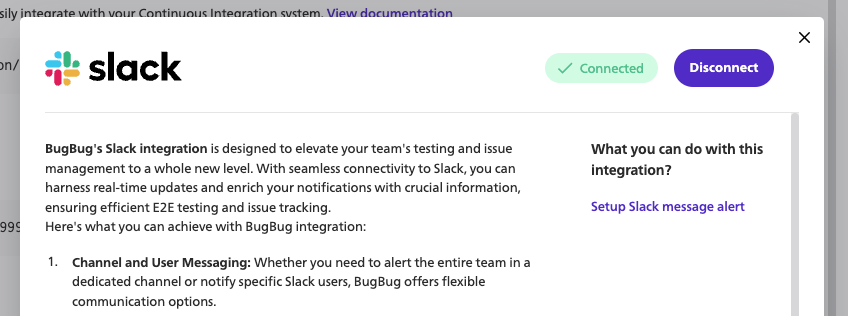
After the last step, you will be automatically redirected to the "Integration Details" page.
### Create a Slack message alert
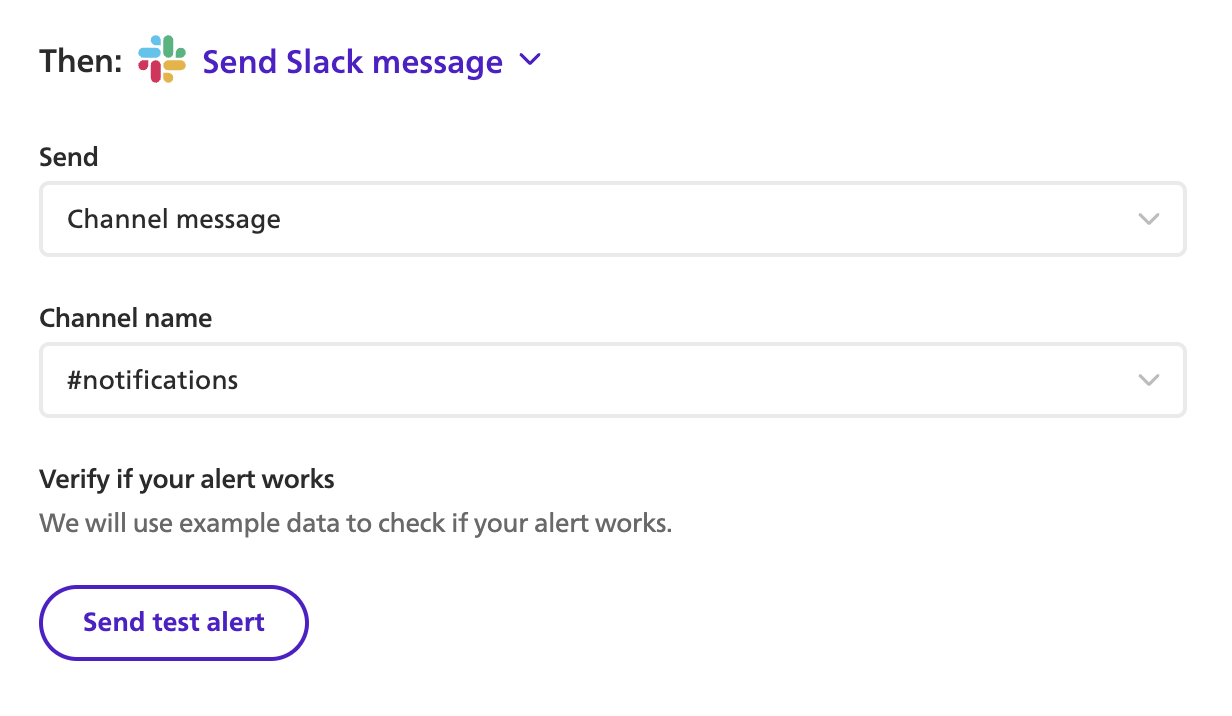
On this page, you can click the "Send a Slack message alert" link. This takes you to the "New Alert" view, where you can configure your first Slack message alert, eg. the message type or recipient.
If you don't know how to set up [Alerts](/collaboration/alerts.md), you can read more about how to do it [here](/collaboration/alerts.md#adding-a-new-alert-to-your-project).
***
## Using Zapier integration
[Use Zapier for connecting BugBug to Slack to get notifications -->](/integrations/zapier.md)
### Explore other ways of integrating BugBug with Slack
Check out other templates for [integrating BugBug with Slack](https://zapier.com/apps/bugbug/integrations)

---
# Agent Instructions
This documentation is published with GitBook. GitBook is the documentation platform designed so that both humans and AI agents can read, navigate, and reason over technical content effectively. Learn more at gitbook.com.
## Querying This Documentation
If you need additional information that is not directly available in this page, you can query the documentation by asking a question.
Perform an HTTP GET request on the following URL with the `ask` and `goal` query parameters:
```
GET https://docs.bugbug.io/integrations/slack.md?ask=&goal=
```
`ask` is the immediate question: it should be specific, self-contained, and written in natural language.
`goal` is what the user is ultimately trying to achieve, the reason they need the answer. Sharing it helps GitBook give you a better, more relevant answer. A goal is most helpful when it describes the outcome the user wants rather than restating the question. For example, with `ask=how do I create an API token`, a goal like `automate deployments from our CI pipeline` lets GitBook tailor the answer to that use case.
The response will contain a direct answer to the question and relevant excerpts and sources from the documentation.
Use this mechanism when the answer is not explicitly present in the current page, you need clarification or additional context, or you want to retrieve related documentation sections.